


About Stoneworld
Who we are, what we do, and why Australia's leading trade professionals choose Stoneworld.
Who is Stoneworld?
Stoneworld is a nationwide tile and stone wholesaler with over 35 years of experience supplying the Australian trade industry. We work exclusively with businesses — including tile retailers, builders, architects, interior designers, and joinery companies — providing access to an extensive range of tiles and stone surfaces at wholesale pricing.
Does Stoneworld sell directly to the general public?
No. Stoneworld operates exclusively as a B2B wholesaler. We do not sell directly to the general public, and our warehouses are not open for public showroom visits. If you're a homeowner or renovator looking for our products, we recommend looking for your local tile retailer here.
Where are Stoneworld's warehouses located?
Stoneworld operates warehouses in Girraween NSW, Loganholme QLD, Lara VIC, Osborne Park WA, enabling nationwide distribution.
What product categories does Stoneworld carry?
Stoneworld stocks a wide range of tiles and surfaces including porcelain, ceramic, mosaic, natural stone, bluestone, travertine, marble, limestone, and more.
Downloads
Access and download our technical guides, maintenance manuals, and product resources.
Stoneworld Tile & Stone Maintenance Manual
A comprehensive care guide for tiles and natural stone surfaces. Covering ceramic, porcelain, and a full range of stone types — from marble to travertine — this manual walks through cleaning methods, stain removal, sealing, and slip compliance in line with Australian Standards.
Safety Data Sheet
Essential safety information for handling, cutting, and processing Stoneworld porcelain, ceramic, and mosaic tiles — including hazard classifications, PPE requirements, and Safe Work Australia compliance guidelines.
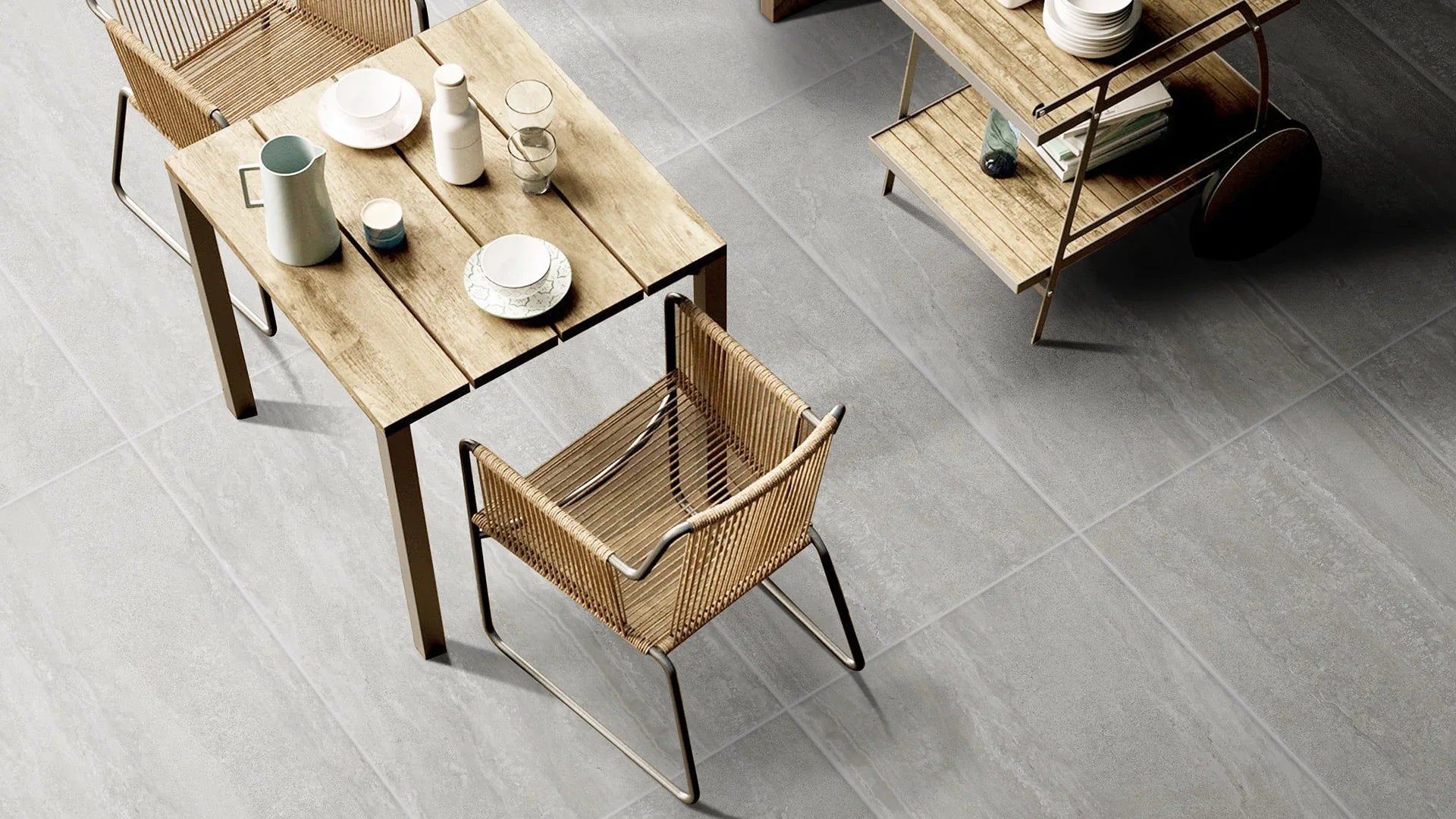

Smooth to touch. Built to grip.
Inspired by nature's own anti-slip engineering, Stoneworld's SmoothGrip Finish delivers the look and feel of a premium indoor tile — anywhere in your home, inside or out. No roughness. No compromise.
Tile Glossary
Understanding tile and stone terminology helps you make confident decisions for your project. This glossary covers the key terms you'll encounter — from materials and finishes to installation and quality standards. If you have any questions, our team at Stoneworld is always happy to help.
A
Abrasion Resistance
The degree to which a tile surface will withstand friction and foot traffic wear. In Australia, tiles are classified from Group I (light residential traffic) to Group V (heavy commercial traffic) per AS 4459-7. The P.E.I. rating (1–5) is also commonly used, with 5 being the most durable.
Absorption
The amount of water a tile can absorb, expressed as a percentage of its dry weight. High absorption indicates a porous structure susceptible to staining; compact, vitrified tiles have very low absorption. Critical for determining frost resistance and outdoor suitability.
Adhesive / Bonding Material
Any mortar or adhesive used to bond tiles to a substrate. Types include cement-based, epoxy, and organic (mastic) adhesives. Selecting the correct adhesive for the tile type and application area is critical to installation success.
B
Batch
Tiles produced from a single production run using the same clay or glaze mix. Because batches vary slightly in shade, colour and calibration, it is essential to use tiles from the same batch number for a continuous installation area.
Bevel / Bevelled Edge
Where the edge of a tile is cut at an angle rather than perpendicular to its face, creating a subtle shadow line at the joint.
Biscuit / Body (of Tile)
The structural portion of a ceramic tile — the clay material — as distinct from the glaze. Also called the bisque.
Bullnose Tiles
Trim tiles featuring one rounded, finished edge, used to cap the top of wall tiles, turn outside corners or finish stair nosings. Double-bullnose tiles have two rounded edges.
C
Ceramic Tiles
Tiles made from red or white clay, moulded and fired in a kiln. Almost always finished with a decorative glaze. Softer than porcelain, easier to cut, and generally rated PEI 0–3. Best suited to walls and lighter residential floor traffic.
Chemical Resistance
The ability of a tile surface to withstand damage from chemicals, acids, alkalis and swimming pool salts. Glazed porcelain and epoxy-grouted surfaces generally offer the highest chemical resistance.
Chiselled Edge
A mechanically chipped tile edge that gives natural stone a rustic, aged appearance. Common on travertine, limestone and sandstone tiles.
Cladding
Stone or tile veneer applied to wall surfaces as a non-structural facing, typically fixed mechanically for installations above 3 metres. Used externally and internally for aesthetic and protective purposes.
Coefficient of Friction (COF)
A measurement of the resistance to slipping on a tiled surface, assessed under wet and dry conditions. Determines suitability for pedestrian surfaces in different applications (see also Pendulum Test and R-Rating).
Colour Bodied (Through Bodied)
Tiles in which a coloured stain runs from the glazed surface throughout the entire body, so that any chips or scratches are less visible. The surface pattern does not, however, continue through the tile body.
Crazing
Fine hairline cracking on the glazed face of a tile, caused by tensile stress between the tile body and glaze (differential thermal expansion). May also be produced deliberately for decorative effect.
D
Double Pressed
A manufacturing process in which a porcelain tile passes through the press, receives decoration, and is then pressed again before entering the kiln. Creates a highly realistic stone appearance and seals the surface for lower porosity.
Dry Floor Friction Test (FFT)
A test method that drags a slider across a dry pedestrian surface at constant speed to measure the apparent coefficient of friction. Not appropriate for assessing surfaces that may become wet. As of AS 4586—2013, results are classified D0 or D1.
E
Edge (Rectified vs Non-Rectified)
Rectified tiles are cut to a precise 90-degree edge after firing, allowing minimal grout joints and a contemporary finish. Non-rectified (pressed edge) tiles have a slight natural variation in size and a small chamfer, requiring wider grout joints.
Epoxy Grout
A two-part grout (resin + hardener) that is impervious, stain-resistant and chemically resistant. Recommended for commercial kitchens, food preparation areas and pools.
Extruded Tiles
Tiles formed by forcing malleable or plastic raw clay through a die, then cutting to shape before firing. Single-extruded tiles are cut from a flat slab; double-extruded (split) tiles are cut from a column that is split prior to cutting.
F
Finishes
The textural and visual surface characteristics of a tile. Common finishes include: gloss, semi-polished (lappato), polished, matt, honed, grip/textured, brushed, bush-hammered, and tumbled. Natural stone also includes unfilled-honed, filled-honed, sandblasted, flamed and sawn-cut finishes.
Fire Resistance
Ceramic tiles are non-combustible and will not release toxic emissions at any temperature, making them 'deemed to satisfy' the fire rating requirements of the Building Code of Australia (BCA) for wall and floor cladding.
Fissure
A fine, hairline opening in the face of natural stone, representing the stone's natural structural characteristics. Distinguished from a crack by being inherent to the stone rather than damage.
French Pattern (Versailles Pattern)
A classic paving layout using four different tile sizes — typically two squares and two rectangles in large and small versions — laid in a repeating, symmetrical arrangement. Commonly used for outdoor courtyards and pool surrounds.
Frost Resistance
The ability of low-absorption tiles (below 0.5% water absorption) to withstand freeze-thaw cycles without damage. Fully vitrified porcelain tiles are considered frost-proof and suitable for external use in all climates.
Full-Bodied (Through-Bodied) Porcelain
Porcelain tile in which the colour and pattern run through the entire thickness of the tile, providing excellent resistance to wear, scratches and chipping. Ideal for high-traffic commercial floors.
Fully Vitrified
Tiles that have been fired to the point where the clay body is fused into an extremely dense material with water absorption below 0.5%. Porcelain tiles are fully vitrified. See also Porcelain Stoneware.
G
Glass Mosaic
Mosaic tiles composed entirely of glass, or ceramic tiles coated with a coloured or transparent glass layer. Available in a wide range of colours and finishes; used in pools, feature walls and wet areas.
Glaze
A glassy, opaque or transparent coating fused onto the ceramic tile body during firing, creating a smooth, impermeable surface. Carries the tile's decorative colour and pattern.
Glazed Porcelain
Currently the most popular type of indoor floor tile. Made from porcelain clay, but with a decorative glaze applied to the surface. Dense, strong and highly wear-resistant; typically requires a wet saw to cut.
Granite
A coarse-grained, visibly granular igneous rock composed chiefly of quartz and feldspars, often with mica or hornblende. Colours range from pink to light or dark grey. Extremely hard and durable; widely used for benchtops, floor tiles, cladding and external paving.
Grout
A cementitious or resin-based material used to fill the joints between tiles after installation. Available in a range of colours. Sanded grout is used for joints wider than ~2 mm; unsanded (fine) grout for narrower joints. Epoxy grout offers superior stain and chemical resistance.
Grout Joint
The gap left between tiles, filled with grout. Typical widths: 1.5–2 mm for rectified indoor tiles; 3–5 mm for unrectified or outdoor tiles. Australian Standards require a minimum 2 mm joint to allow for expansion.
H
Hand-Formed Tiles (Handmade)
Tiles shaped by hand rather than machine, resulting in pleasing natural variation in size, thickness and surface texture. This inherent imperfection is considered a feature and adds character to the installation.
Herringbone Pattern
A tile layout in which rectangular tiles are arranged at 90-degree angles to each other in a V-shape, creating a classic zigzag pattern. Popular for timber-look, subway and mosaic tiles.
Honed Finish
A smooth, satin surface with little or no gloss, produced by polishing with abrasive pads but stopping short of a full polish. Recommended for commercial floors and natural stone applications where a softer look is desired.
I
Impact Resistance
The ability of a tile to resist breakage from a heavy blow. Ceramic tile is generally not resilient — avoid dropping sharp or heavy objects on its surface. Glazed tiles are more susceptible to surface chipping than unglazed tiles.
Impervious Tile
A tile with water absorption of 0.5% or less. Typically refers to fully vitrified porcelain stoneware.
Inkjet Printing Technology
A modern tile manufacturing method that uses high-resolution inkjet printers to apply highly detailed, photorealistic designs to the tile surface. Enables near-perfect replication of natural stone, timber and other materials, with each tile featuring a unique variation.
J
Jolly Tiles
Trim tiles mitred along one or two edges at a 45-degree angle, used for corner and countertop installations to create a neat, finished edge without a separate trim piece. Also called mitered tiles.
L
Lamination (Stone)
Gluing two pieces of stone together to produce a thicker edge profile that can be shaped for benchtops, vanities or other architectural features.
Lappato Finish (Semi-Polished)
A finish achieved by partially polishing the tile surface with an abrasive wheel for less time than a full polish, resulting in a soft, low sheen. Sits between matt and fully polished. Also called semi-polished.
Large Format
A broad term for tiles larger than approximately 600 × 600 mm. Large-format tiles include planks (300 × 900 mm), slabs and panels. They create a seamless, spacious appearance, particularly when paired with rectified edges and minimal grout joints.
Limestone
A sedimentary rock composed principally of calcite or dolomite. Ranges from creamy white to grey and warm tan tones. Recrystallised and compact limestone types that accept a polish are often sold as 'commercial marble'. Naturally porous — sealing is recommended.
Linear Thermal Expansion
The change in the dimensions of a tile or stone material as a result of temperature change. An important consideration when specifying tiles for outdoor use or underfloor heating.
Lippage
The condition in a finished installation where one edge of a tile is higher than an adjacent tile, creating an uneven surface. Can be a trip hazard. Minimised by using levelling systems, proper substrate preparation and consistent adhesive bed depth.
Listello
A narrow decorative border tile, often designed to complement a range of field tiles. Used to create a horizontal or vertical feature band in a wall installation.
Lustre
An iridescent or metallic decorative surface effect on a glaze, usually produced by applying a very thin film of metallic oxide (gold, silver, platinum, copper) over the glaze surface.
M
Marble
A metamorphic rock composed primarily of calcite or dolomite crystals, formed by the heat and pressure transformation of limestone. Ranges from white to grey, black, pink, green and yellow. Widely used for flooring, wall cladding, vanity tops and feature surfaces. Requires sealing.
Matt Finish
A smooth, non-reflective surface finish that absorbs light rather than reflecting it, creating a softer, more contemporary look. Often preferred for living areas and hallways due to good slip resistance and resistance to showing scratches.
Mohs' Scale
A scale from 1 (talc, softest) to 10 (diamond, hardest) used to measure a material's resistance to scratching and abrasion. Relevant to stone tile selection: exterior dirt and grit typically rates 3–7 on the scale.
Modular Format
A tile layout combining multiple sizes from the same series to create a more complex, visually interesting pattern — typically a mix of 2–4 different tile sizes laid together.
Monocottura
Italian for 'single firing'. A production process in which the tile body and glaze are fired together in one high-temperature pass through the kiln. Produces a harder, denser result than bicottura; moisture absorption is below 3%.
Monoporosa
Single-fired tiles with a higher porosity and water absorption than monocottura tiles. Typically used on interior walls only.
Mosaic Tiles
Small tiles, generally less than 150 mm square, available in ceramic, porcelain, glass, stone, or metal. Usually supplied pre-mounted on mesh sheets for easier installation. Used for feature walls, pool interiors, splashbacks and decorative floors.
N
Natural Cleft Finish
A surface naturally created when layered stone (such as slate or quartzite) is cleaved along its natural seam, leaving a rough, textured surface on both faces.
Natural Stone
Stone formed by nature — including granite, marble, limestone, slate, travertine, sandstone, basalt and quartzite — that is quarried and cut rather than manufactured. Each piece is unique and may require sealing.
Nominal Size
The approximate stated size of a tile's face or thickness. Actual tile dimensions may vary from nominal size by an allowable tolerance (typically ±0.5–2 mm depending on tile type and standard).
Non-Rectified Edge (Pressed Edge)
The natural edge of a tile as it comes from the press mould, with slight dimensional variation and a small chamfer. Requires wider grout joints (typically 3–5 mm) to accommodate variation between tiles.
Non-Vitrified Tile
A tile with water absorption of 7% or greater. Suitable for interior, dry-area wall use only.
O
Oil-Wet Inclining Platform Test (Ramp Test)
A test method for classifying tiles intended for industrial applications. Test operators wearing specified footwear walk on a platform coated with oil at increasing angles; results are expressed as an R-rating (R9–R13).
P
P.E.I. Rating (Porcelain Enamel Institute)
A rating system (1–5) for the abrasion resistance of glazed tiles. Group 1: bathroom with soft footwear. Group 2: general residential. Group 3: all residential and light commercial. Group 4: medium commercial (hotels, restaurants). Group 5: heavy commercial and wet external areas.
Pencil Tiles
Narrow rectangular tiles (typically ~20 × 200 mm), sometimes with a rounded or bevelled surface, used as accent pieces or borders on tiled walls.
Pendulum Test (Wet Pendulum Test)
The standard Australian test method for slip resistance of hard and resilient floor surfaces (AS 4586). A pendulum with a rubber slider makes contact with the wet surface over a prescribed distance; results are classified P0 (very high slip risk) to P5 (very low slip risk).
Permeability
The extent to which the pores and capillary structures within a stone or tile are interconnected, affecting the depth and rate of moisture absorption. A stone may have low porosity but high permeability if its pore network is well-connected.
Polished Finish
A highly reflective, glassy surface finish produced by grinding and polishing with progressively finer abrasives. Brings out the full depth of colour and pattern in the tile or stone. Polishing removes up to 1 mm of material from the surface.
Pool Coping / Nosing
A bullnose-edged tile or stone cap installed along the perimeter of a swimming pool to provide a finished, comfortable and slip-resistant edge. Often features a drip groove on the underside.
Porcelain Stoneware (Porcelain Tiles)
Dust-pressed ceramic tiles made from fine porcelain clays, fired at high temperatures (≥1,200 °C) to produce a dense, impervious, fine-grained tile with water absorption below 0.5%. Frost-resistant and suitable for any application from residential to heavy commercial. Also referred to as fully vitrified.
Porosity
The ratio of void (pore) volume to total tile body volume, measured by the percentage of water a dry tile absorbs after 24-hour immersion. High porosity equals greater stain risk. See Water Absorption.
Q
Quarry
The site where natural stone is extracted from the earth in open pit or underground mining operations.
Quarry Tiles
Traditional single-extruded, natural clay tiles with a water absorption not exceeding 6%. Available glazed or unglazed; valued for their slip resistance and durability in commercial and outdoor applications.
Quartzite
A hard metamorphic rock originating as sandstone, rating approximately 7 on Mohs' scale. Usually white to grey, but can be pink, red or gold. Highly durable and suitable for high-traffic flooring and external paving.
R
Rectified Tile
A tile that has been cut and ground to precise dimensions after firing, resulting in sharp 90-degree edges with a tight size tolerance. Allows installation with very fine grout joints (2–3 mm), creating a seamless, contemporary appearance.
R-Rating (Ramp Test)
A slip resistance classification from oil-wet ramp tests used for industrial environments. Ratings R9 (lowest resistance) to R13 (highest resistance) indicate the angle at which slip occurs under oil-wet conditions.
S
Sandstone
A sedimentary rock composed primarily of cemented sand grains. The cementing agent (silica, calcium carbonate, iron oxide) determines hardness and colour, ranging from buff and cream to red and brown. Porous — sealing is recommended for indoor and outdoor use.
Screed
A smoothing layer of sand-and-cement mortar (typically 12–20 mm) applied to uneven concrete substrates before tiling. Self-levelling compound is an alternative for minor irregularities.
Sealants / Sealers
Clear penetrating or topical coatings applied to unglazed tiles and natural stone to protect against staining, moisture and grease. Penetrating sealants maintain the stone's natural appearance; enhancing sealants deepen and enrich colours. Not required for glazed tiles.
Self-Levelling Compound
A two-part, rapid-drying compound poured over a screeded floor to create a perfectly flat surface suitable for tiling.
Shade Variation (V-Rating)
The degree of colour and tone variation between individual tiles in a batch. Rated V0 (identical) to V4 (high/random variation). V3–V4 is most common for natural stone-look tiles and terracotta. Always source tiles from the same batch for continuous areas, and blend tiles from multiple boxes during installation to minimise visible variation.
Slab
A large, lengthwise-cut piece of stone sawn from a quarry block, typically used for benchtops, flooring and cladding in its full natural size.
Slate
A fine-grained metamorphic rock formed from shale, composed mainly of mica, clay and quartz. Characterised by its natural cleft surface and planar cleavage. Available in blue-grey, green, purple and rust tones. Popular for flooring, wall cladding and external paving.
Slip Resistant Tiles
Tiles treated or manufactured to reduce the risk of slipping, by adding abrasive grit (corundum) to the glaze, texturing the surface with ribs or studs, or through processes such as acid etching. Must be assessed against Australian Standards AS 4586.
Spacers
Cross-shaped plastic pieces placed between tiles during installation to ensure a consistent, even grout joint width. Available in various thicknesses (1 mm, 1.5 mm, 2 mm, 3 mm, 5 mm).
Splashback / Backsplash
Vertical tile cladding on the wall immediately behind a sink, cooktop or basin, protecting the wall from water and food splatter.
Stacked Bond
A tile layout in which all vertical and horizontal joints run continuously (no offset) across the entire tiled surface, creating a grid pattern.
Substrate
The underlying surface onto which tiles are bonded. May be a concrete slab, compressed fibre cement sheet, existing tiles (in renovation), or waterproofed framing. Substrate preparation is critical to a successful installation.
Subway Tiles
A popular rectangular wall tile format, classically 75 × 150 mm or 100 × 200 mm, named after the tiles used in the New York City subway in the early 1900s. Now available in many elongated formats and finishes.
T
Tactile Indicators
Purpose-designed tiles with raised dots (hazard) or strips (directional) to assist vision-impaired pedestrians. Must meet 30% luminance contrast requirements per AS/NZS 1428.4 and comply with AS/NZS 4586 for slip resistance.
Terracotta
Traditional natural clay used to produce unglazed tiles ranging from cream to deep red in colour, generally extruded and 12 mm or more thick. From the Italian for 'baked earth'. Surface may be rustic, smooth, polished or waxed. Highly porous — sealing is essential.
Terrazzo
A composite flooring material originally developed in 15th-century Venice, consisting of marble or stone chips set in cement or resin, then ground and polished to a smooth surface. Now also available as pre-manufactured porcelain tiles replicating the terrazzo aesthetic.
Thermal Shock Resistance
The ability of a tile to withstand rapidly fluctuating extreme temperatures without cracking or spalling. Important for tiles near fireplaces, cooktops, or in climates with large temperature variations.
Thin-Set (Thinset)
A cement-based adhesive (tile adhesive) used to bond tiles to a substrate in a thin-bed (3–6 mm) installation. Available in standard, flexible and rapid-setting formulations.
Travertine
A form of dense, banded calcium carbonate deposited by hot or cold springs. Characterised by naturally occurring pitted holes and troughs. Available filled or unfilled, in finishes from polished to brushed. Popular for paving, pool surrounds, wall cladding and flooring. Colours range from ivory and beige to walnut and grey.
Tread Tiles (Step-Nose Tiles)
Trim tiles for stairs featuring a ridged, abrasive or nosing profile to prevent slipping. May be overhanging (bull-nose nosing) or flush-abutted to the riser.
U
Unglazed Tiles
Tiles that are used directly from the kiln without an applied glaze. Colour and texture derive from the raw materials and fired body. Generally fully vitrified (in the case of porcelain) or natural clay. Often require sealing for stain protection.
V
V-Rating (Shade Variation)
The degree of colour and tone variation between individual tiles in a batch. Rated V0 (identical) to V4 (high/random variation). V3–V4 is most common for natural stone-look tiles and terracotta. Always source tiles from the same batch for continuous areas, and blend tiles from multiple boxes during installation to minimise visible variation.
Vein Cut
Stone slabs cut perpendicular to the natural bedding plane, revealing long, flowing veins across the tile face. Produces a linear, dramatic pattern. Contrasts with cross-cut (fleuri cut), which reveals a more cloud-like or floral pattern.
Vitrified Tiles
Tiles with extremely low porosity achieved by firing at high temperatures (1,250 °C+). Vitreous tiles absorb less than 3% moisture; fully vitrified (porcelain) tiles absorb less than 0.5%. See also Porcelain Stoneware.
W
Wall Tiles
Generally glazed, non-vitreous tiles for interior wall applications where abrasion and impact resistance are not primary requirements. Not intended for floor or outdoor use.
Warpage
A dimensional defect in which a tile's surface is not perfectly flat, with one or more corners lying out of plane. An allowable tolerance is defined by Australian and international standards.
Wastage
The additional quantity of tiles (typically 10%) ordered to account for cuts, breakage, and future replacements. Increase to 15% for complex layouts, large-format tiles, or diagonal/herringbone patterns.
Water Absorption
The quantity of water a tile can absorb, expressed as a percentage of the dry tile weight. Classification: impervious (<0.5%), vitreous (<3%), semi-vitreous (3–7%), non-vitreous (>7%). Determines frost resistance, stain susceptibility and suitable applications.
Waterproofing Membrane
A liquid-applied or sheet membrane installed over the substrate in wet areas (showers, bathrooms, laundries) before tiling, to prevent water ingress into the building structure. Required by the Building Code of Australia in all wet areas.
Wet Barefoot Inclining Platform Test
A slip resistance test in which barefoot operators walk on a continuously water-wetted, gradually inclining platform. Used to classify tiles for barefoot wet areas such as showers, pool surrounds and change rooms. Results expressed as a barefoot 'A', 'B' or 'C' classification.
The definitions in this glossary are provided as a general reference guide only. Product specifications, standards and installation requirements may vary. Always confirm details with your supplier or a qualified tiling professional. Australian Standards referenced include AS 4459-7, AS 4586 and HB 198. Stoneworld accepts no liability for any loss, damage or injury arising from the use or reliance on the information contained in this glossary.